- [email protected]
- Fevzipaşa Mah. Kınalı Kavşağı Cad. No:123 ve 123/1 Silivri / İstanbul
Torch-Applied vs Self-Adhesive Membranes
Torch-Applied vs Self-Adhesive Membranes
Modified bitumen membranes are widely used in roofing and waterproofing applications. Depending on the installation method, these membranes are generally classified into two main categories:
- Torch-applied membranes
- Self-adhesive membranes
Both systems provide effective waterproofing performance when correctly specified and installed. However, they differ significantly in application technique, adhesion mechanism, safety considerations, and project suitability.
Understanding the differences helps contractors and project consultants select the most appropriate solution.
1. Torch-Applied Membranes
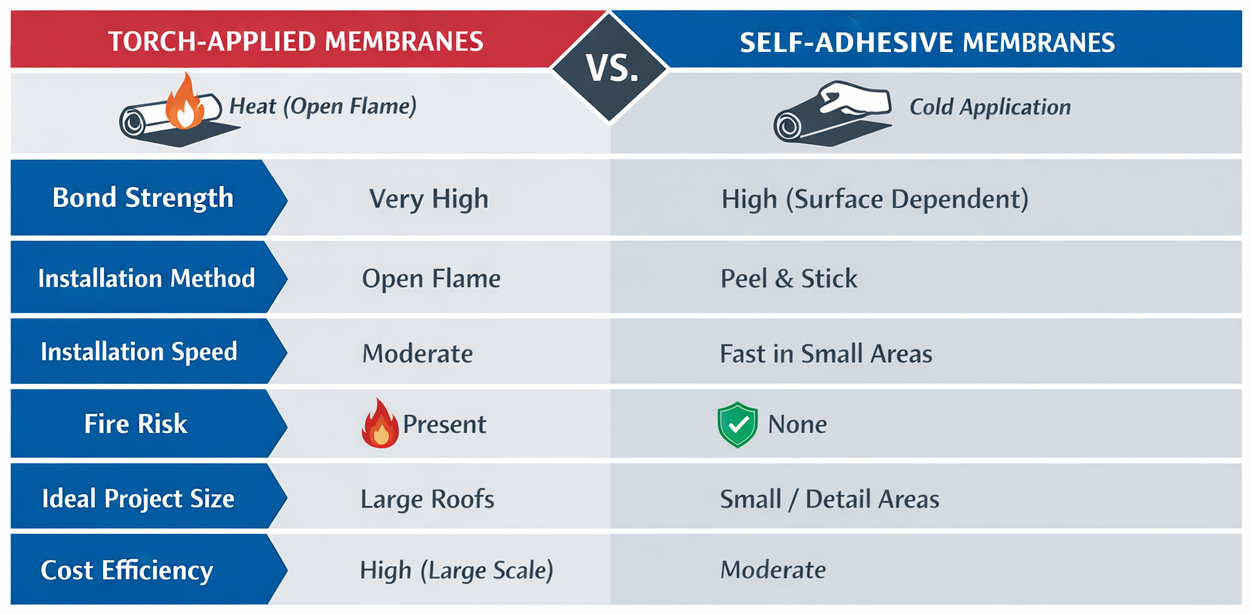
Torch-applied membranes are installed using an open flame torch that heats the underside of the membrane. The bitumen compound melts and bonds directly to the substrate.
Key Characteristics
- Heat-activated bonding
- Strong mechanical adhesion
- Suitable for large-scale projects
- Proven long-term performance
Advantages
- Excellent bond strength
- Reliable seam welding
- High resistance to water infiltration
- Cost-effective for large roof areas
Considerations
- Requires skilled applicators
- Open flame may pose fire risk
- Not suitable for flammable substrates without protection
Torch-applied systems are widely used in industrial, commercial, and large residential projects due to their durability and performance consistency.
2. Self-Adhesive Membranes
Self-adhesive membranes are factory-coated with a pressure-sensitive adhesive layer protected by a removable release film. Installation does not require heat.
Key Characteristics
- Cold application method
- No open flame
- Cleaner installation process
- Reduced installation time in small areas
Advantages
- Safer for fire-sensitive environments
- Ideal for enclosed spaces
- Suitable for residential applications
- Lower installation risk
Considerations
- Adhesion depends on surface preparation
- Not ideal for very large roof areas
- Slightly higher material cost
- Temperature-sensitive during application
Self-adhesive membranes are commonly preferred for detail areas, balconies, small roofs, and renovation projects.
Project-Based Selection
Choose Torch-Applied Membranes When:
- The project involves large roof surfaces
- Long-term durability is the priority
- Skilled applicators are available
- Substrate allows safe torch use
Choose Self-Adhesive Membranes When:
- Fire safety is critical
- The project is residential or renovation-based
- Installation is in confined areas
- Speed and simplicity are required
Performance and Lifecycle Considerations
Torch-applied membranes typically provide stronger bonding due to heat fusion, making them highly durable under heavy mechanical and environmental stress.
Self-adhesive membranes offer convenience and safety advantages but require careful surface preparation to achieve optimal adhesion.
System selection should consider not only installation method but also climate, substrate type, and project size.
Conclusion
Both torch-applied and self-adhesive membranes provide reliable waterproofing when properly installed.
Torch-applied systems are ideal for large-scale projects requiring maximum bond strength and durability.
Self-adhesive membranes are suitable for fire-sensitive environments and smaller applications where safety and ease of installation are priorities.
At Standart Insulation, we provide both application options to ensure flexible solutions tailored to project-specific requirements.
Choosing the right installation method enhances performance, safety, and long-term waterproofing reliability.