
- [email protected]
- Fevzipaşa Mah. Kınalı Kavşağı Cad. No:123 ve 123/1 Silivri / İstanbul

Difference Between APP and SBS Modified Bitumen Membranes
Difference Between APP and SBS Modified Bitumen Membranes
As a manufacturer and exporter of waterproofing systems, Standart Insulation produces both APP and SBS modified bitumen membranes to meet diverse climate and project requirements worldwide.
Modified bitumen membranes are engineered by enhancing traditional bitumen with polymer modifiers. The two most widely used modifiers are:
- APP (Atactic Polypropylene) – thermoplastic-based modification
- SBS (Styrene-Butadiene-Styrene) – elastomeric (rubber-like) modification
Although both systems are designed to provide durable waterproofing protection, their mechanical behavior and climate performance differ significantly.
Understanding these differences is essential for selecting the correct system for long-term performance.
APP Modified Bitumen Membranes
APP membranes are produced by modifying distilled bitumen with Atactic Polypropylene, a thermoplastic polymer that enhances heat resistance and UV stability.
At Standart Insulation, APP membranes are engineered for projects exposed to high solar radiation and elevated ambient temperatures.
Technical Advantages of APP Membranes
- Excellent high-temperature resistance
- Superior UV durability
- Strong resistance to thermal aging
- Good dimensional stability
- Long service life in hot climates
Because APP behaves like a plastic compound when heated, torch application ensures strong adhesion and seamless waterproofing performance.
Recommended Use
APP membranes are ideal for:
- Middle East projects
- African regions
- Southeast Asian tropical climates
- Industrial roofs exposed to direct sunlight
SBS Modified Bitumen Membranes
SBS membranes are modified with Styrene-Butadiene-Styrene, an elastomeric polymer that provides rubber-like flexibility.
At Standart Insulation, SBS membranes are manufactured for applications requiring superior elasticity and crack-bridging performance.
Technical Advantages of SBS Membranes
- High elongation capacity
- Excellent low-temperature flexibility
- Strong crack-bridging ability
- Improved adhesion to substrates
- Resistance to structural movement
SBS membranes remain flexible even at sub-zero temperatures, making them suitable for regions exposed to freeze-thaw cycles.
Recommended Use
SBS membranes are ideal for:
- European climates
- Cold and temperate regions
- Roofs exposed to structural movement
- Concrete substrates with potential micro-cracking
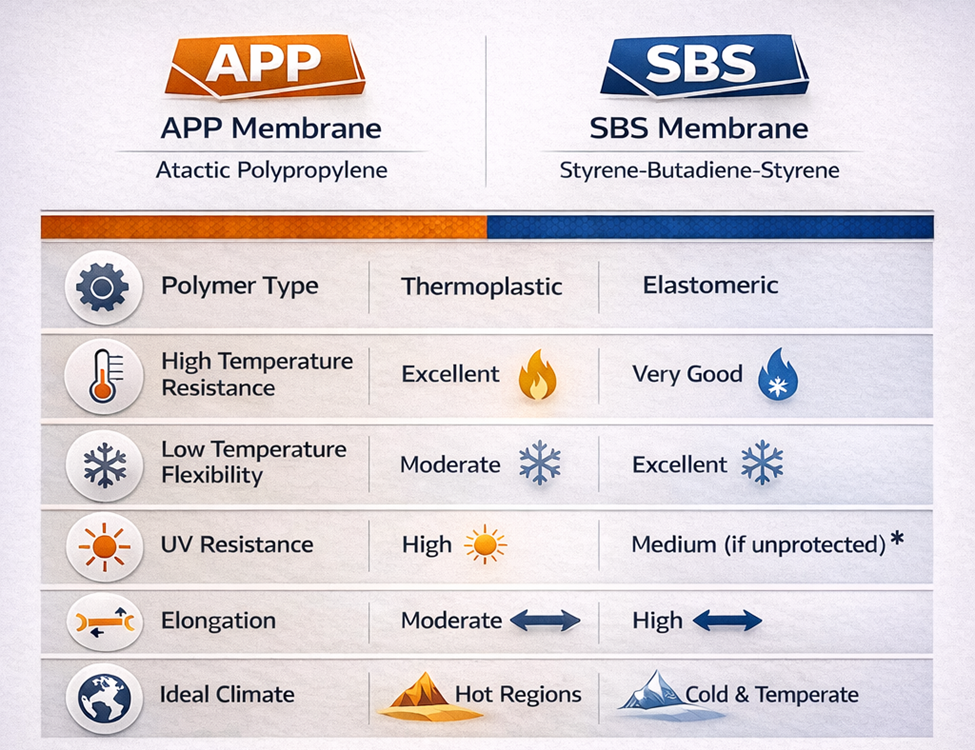
Both systems can be reinforced with polyester or fiberglass carriers depending on tensile strength and elongation requirements.
Climate-Based Selection Approach
At Standart Insulation, system selection is always based on:
- Project location and climate data
- Roof type (flat or pitched)
- Expected service life
- Mechanical exposure
- Local compliance standards
Selecting the wrong membrane type for the climate can significantly reduce lifespan and increase maintenance costs.
For high-heat exposure, APP is typically recommended.
For low-temperature flexibility and structural movement, SBS is preferred.
Manufacturing and Quality Assurance
Standart Insulation manufactures APP and SBS membranes under strict quality control procedures aligned with international standards.
Each production batch undergoes:
- Thickness verification
- Tensile strength testing
- Elongation testing
- Heat resistance testing
- Low-temperature flexibility testing
This ensures consistent export quality for international markets.
Conclusion
APP and SBS modified bitumen membranes are both reliable waterproofing solutions when properly specified.
- APP provides superior heat and UV resistance for hot climates.
- SBS delivers exceptional elasticity and low-temperature performance for colder regions.
At Standart Insulation, we offer both systems to ensure that distributors, contractors, and project owners receive the most suitable waterproofing solution based on their regional and structural requirements.
Correct membrane selection is not only a material choice — it is a long-term performance decision.