
- [email protected]
- Fevzipaşa Mah. Kınalı Kavşağı Cad. No:123 ve 123/1 Silivri / İstanbul

Polyester vs Fiberglass Reinforcement
Polyester vs Fiberglass Reinforcement
Why Reinforcement Matters
In bituminous membranes, reinforcement is the internal carrier layer that:
- Provides mechanical strength
- Controls dimensional stability
- Improves crack resistance
- Affects elongation performance
The two most common reinforcement types are:
Polyester (PET)
Fiberglass (Glass Fiber)
1 Polyester Reinforcement
Structure
Non-woven synthetic polyester fibers.
Key Characteristics
- High elongation capacity
- Excellent flexibility
- Strong crack-bridging performance
- Good fatigue resistance
Technical Advantages
✔ High tensile strength
✔ High elongation (%)
✔ Absorbs structural movement
✔ Suitable for dynamic substrates
Ideal Applications
- Industrial roofs
- Large-span structures
- Cold climates
- Areas with structural movement
Polyester-reinforced membranes are preferred where flexibility and durability are critical.
2 Fiberglass Reinforcement
Structure
Woven or non-woven glass fibers.
Key Characteristics
- Very low elongation
- Excellent dimensional stability
- Rigid structure
- Stable under heat
Technical Advantages
✔ Excellent dimensional stability
✔ Resistant to thermal expansion
✔ Cost-effective
✔ Good for stable substrates
Ideal Applications
- Small roofs
- Stable concrete decks
- Budget-sensitive projects
- Hot climates (where movement is limited)
Fiberglass reinforcement is preferred when structural movement is minimal.
3 Technical Comparison Table
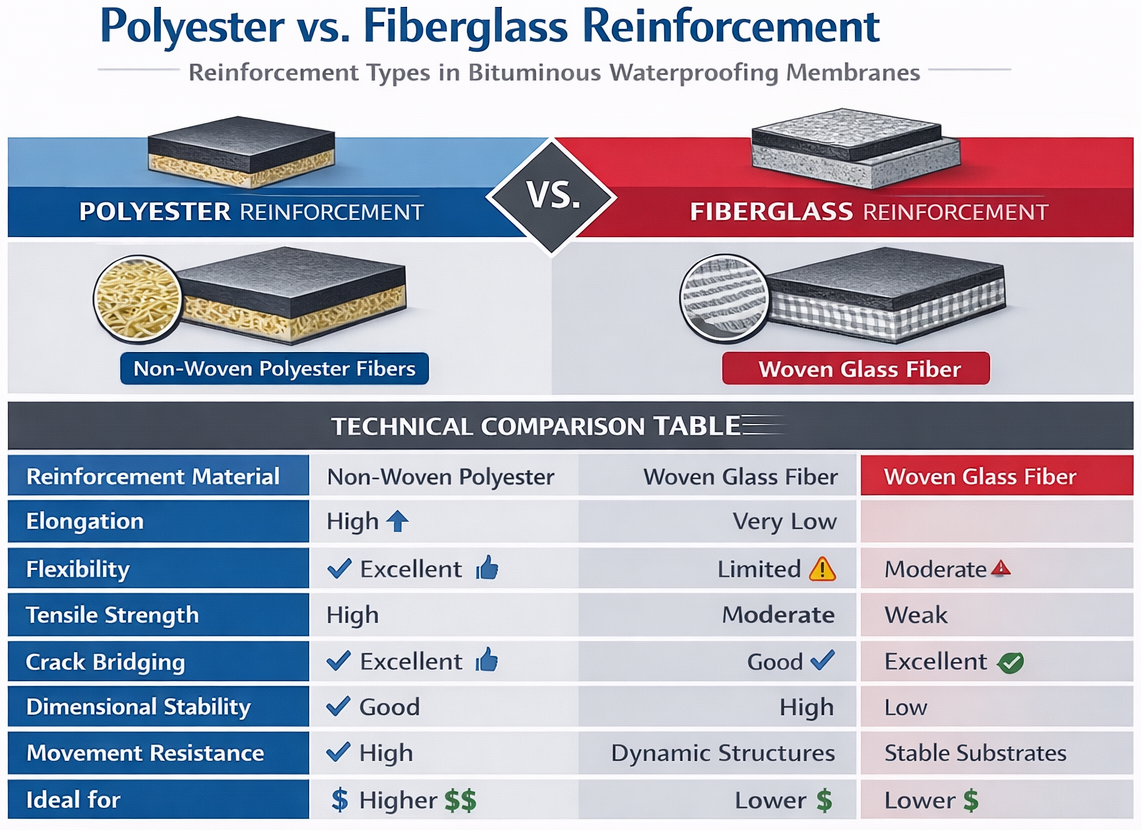
4 Performance Perspective
Polyester = Strength + Flexibility
Fiberglass = Stability + Cost Efficiency
If the roof structure moves → Polyester performs better.
If the substrate is stable → Fiberglass may be sufficient.
5 In APP and SBS Membranes
- SBS + Polyester → High flexibility system (ideal for cold climates)
- APP + Polyester → Durable system for industrial use
- APP + Fiberglass → Cost-effective solution for stable roofs
Conclusion
The choice between polyester and fiberglass reinforcement depends on:
- Climate conditions
- Structural movement
- Budget
- Project lifespan expectations
For long-term durability and dynamic structures, polyester reinforcement is generally preferred.